Research · Article
Quantifying Uncertainty in Strategic Models
Methods for incorporating and communicating uncertainty in business simulations—a practical framework for probabilistic scenario analysis.

The Uncertainty Problem in Strategic Modeling
Every model is wrong. The question is whether it's useful. For strategic decision support, usefulness depends critically on how well uncertainty is incorporated and communicated. Point forecasts create false confidence; probability distributions overwhelm decision-makers. The challenge is finding the right level of uncertainty representation for the decision at hand.
This article develops a practical framework for quantifying, propagating, and communicating uncertainty in simulation models—one that maintains rigor while remaining accessible to non-technical executives.
Sources of Uncertainty
Strategic models face three distinct types of uncertainty:
Parametric Uncertainty
Model parameters (growth rates, conversion rates, capacity limits) are estimated from historical data and expert judgment. Each carries confidence intervals that should propagate through the model to outputs.
Structural Uncertainty
The model structure itself is a hypothesis about how the system works. Alternative structures may be equally plausible. Ensemble approaches can capture this by running multiple model specifications.
Scenario Uncertainty
External factors (market conditions, competitor actions, regulatory changes) follow unknowable paths. Scenario analysis explores discrete alternative futures; Monte Carlo methods sample from probability distributions.
The Communication Challenge
Technical accuracy in uncertainty quantification is necessary but not sufficient. Decision-makers need uncertainty communicated in ways that:
- Support intuition: Fan charts and confidence intervals should map to how executives already think about risk
- Enable comparison: Uncertainty across scenarios must be comparable, not just within scenarios
- Highlight decisions: The focus should be on where uncertainty matters for the choice at hand
- Invite calibration: Stakeholders should be able to test "what if we're wrong about X?"
A Practical Framework
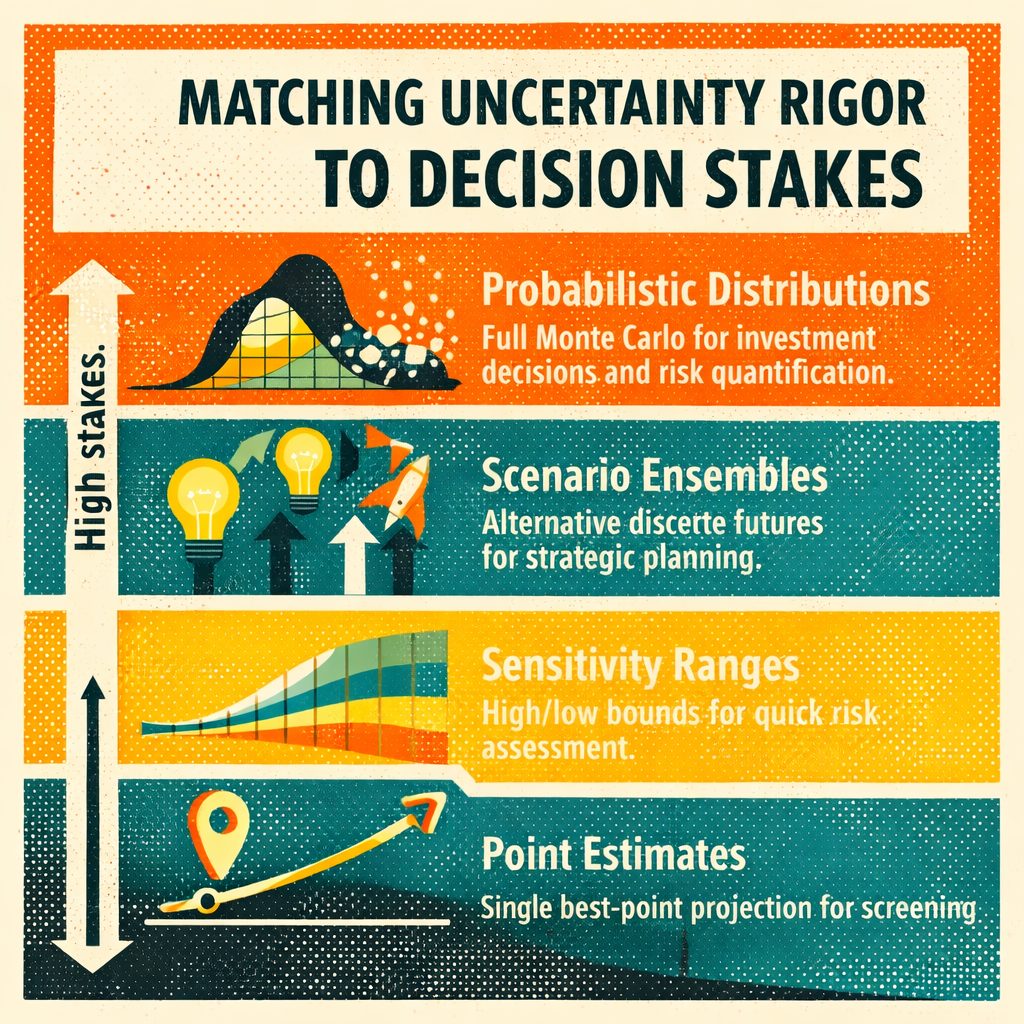
Our framework proposes a four-level approach to uncertainty in strategic models:
- Level 1 - Point estimates: Single best-guess projections for screening and communication
- Level 2 - Sensitivity ranges: High/low bounds on key parameters for quick risk assessment
- Level 3 - Scenario ensembles: Discrete alternative futures for strategic planning
- Level 4 - Probabilistic distributions: Full Monte Carlo for investment decisions and risk quantification
The appropriate level depends on decision stakes, available data, and organizational capacity for probabilistic reasoning.
Implications for Practice
Making uncertainty explicit means fewer surprises during execution and better learning after the decision. The investment in uncertainty quantification pays off not just in better decisions, but in organizational learning and adaptive capacity.