Research · Article
From Operational Intelligence to Decision Intelligence
Closing the gap between visibility and outcomes—how to transform data awareness into strategic action.
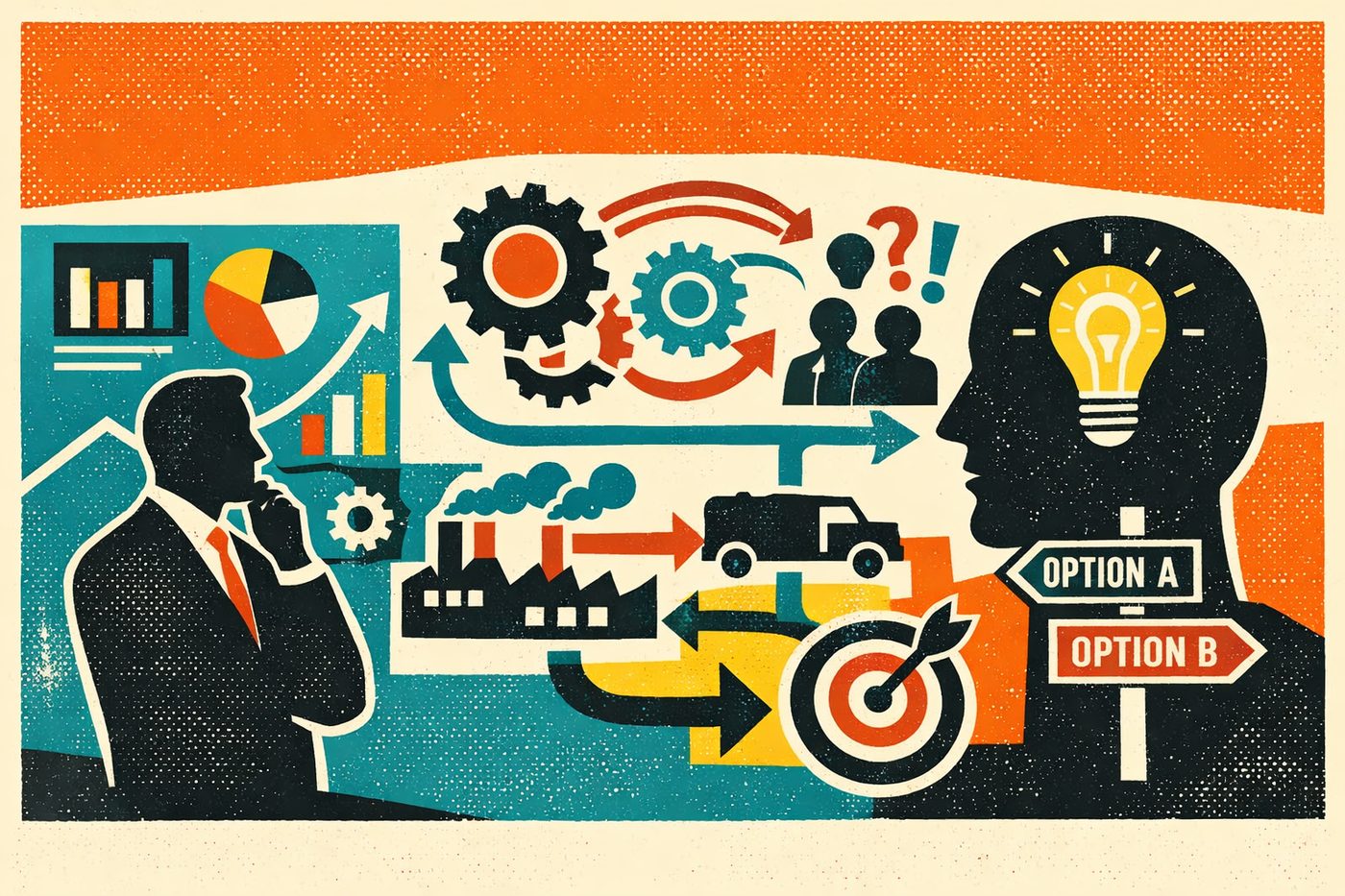
The Hidden Failure Mode in Modern Operations
Most organizations have invested heavily in visibility.
They have dashboards. They have KPIs. They have data pipelines and predictive models.
And yet execution still breaks down.
Projects slip. Revenue leaks across handoffs. Teams optimize locally and hurt the system globally. Decisions look right in reports — and fail in reality.
The issue isn't lack of intelligence.
It's that most tools describe what is happening, not how the system will behave when decisions change.
The Shift: From Seeing Problems to Stress-Testing Decisions
Operational Intelligence answers:
- Where are we inefficient?
- Where are bottlenecks forming?
- Where is execution breaking down?
Decision Intelligence must answer:
- If we fix this bottleneck, what new constraint appears?
- If we accelerate growth, what breaks downstream?
- If we cut cost here, what risk accumulates elsewhere?
- Which intervention creates the highest leverage over time?
In real operations, every fix changes the system.
Why Dashboards and Process Maps Plateau
Dashboards show metrics. Process maps show sequence. Forecasts show likely outcomes.
But real organizations are driven by:
- Feedback loops between teams
- Delays between action and impact
- Human decision behavior
- Policy and incentive structures
- Shared resource constraints
This is why companies repeatedly:
- Solve yesterday's bottleneck
- Create tomorrow's constraint
- Chase performance variability instead of stabilizing systems
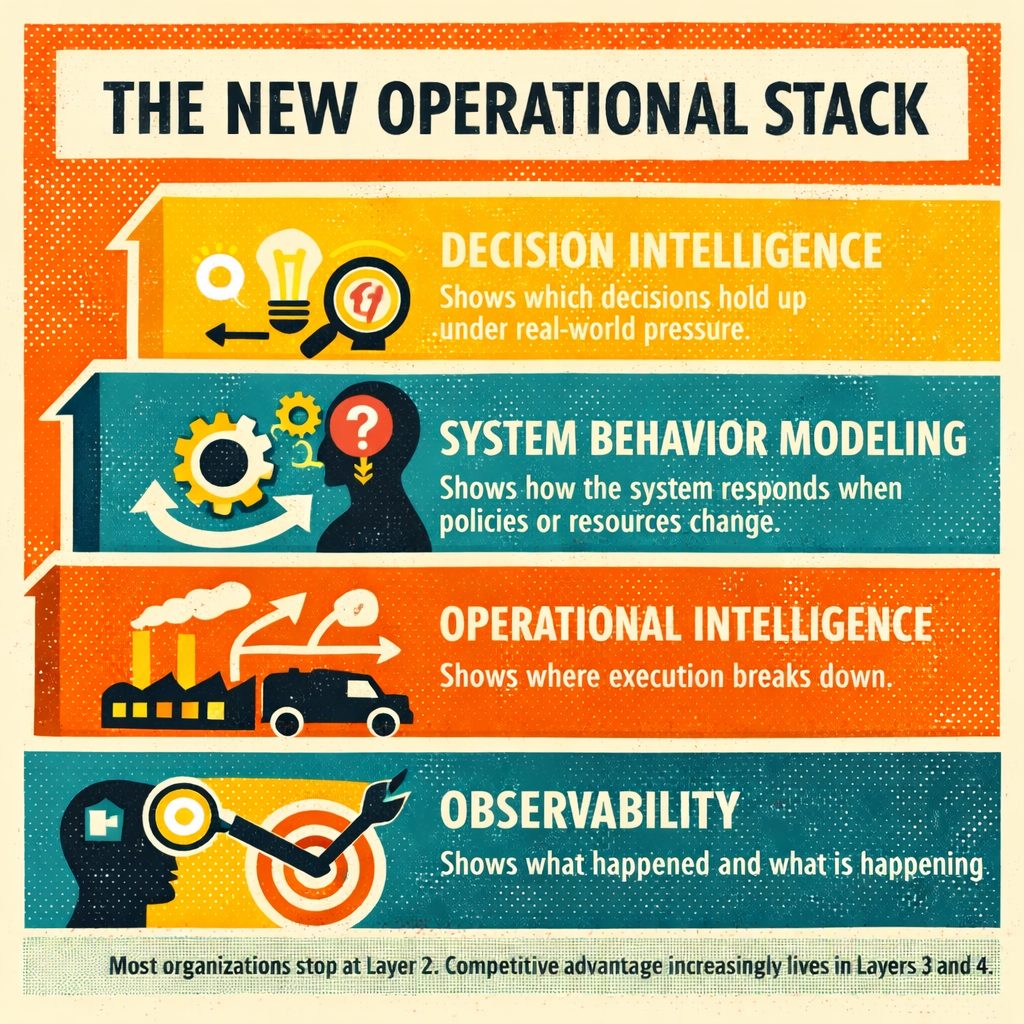
The New Operational Stack
Modern operational transformation is moving toward four layers:
1. Observability
Shows what happened and what is happening.
2. Operational Intelligence
Shows where execution breaks down.
3. System Behavior Modeling
Shows how the system responds when policies or resources change.
4. Decision Intelligence
Shows which decisions hold up under real-world pressure.
Most organizations stop at Layer 2. Competitive advantage increasingly lives in Layers 3 and 4.
Where This Matters Most: SMB and Mid-Market Execution
Large enterprises can absorb inefficiency. SMBs and mid-market companies usually cannot.
In these environments:
- One broken handoff can destroy margin
- One overloaded team can stall growth
- One misaligned KPI can create cross-functional conflict
These organizations don't need more reporting.
They need clear, testable operational decision systems.
What High-Performing Operational Organizations Do Differently
They don't just document processes. They:
- Test decisions before rollout
- Model cross-functional impacts
- Identify leverage points instead of symptoms
- Stress test policies before committing capital or headcount
- Align leadership around system behavior, not department metrics
The Next Evolution of Operational Leadership
The next generation of operational leaders won't be defined by:
- How much data they have
- How advanced their dashboards are
- How many AI tools they deploy
They will be defined by:
- How well they understand system behavior
- How safely they can test decisions
- How clearly they can explain tradeoffs
- How confidently they can act under uncertainty
The End State
Operational Intelligence helped organizations see.
Decision Intelligence helps them choose — and choose in ways that hold up across teams, time, and changing conditions.
Fewer blind spots. Better prioritization. Decisions that last under pressure.