Research · Article
Using Optimization with Simulation to Find the Best Path Forward
How to move from exploring possibilities to identifying the decisions that perform best across competing objectives and uncertain conditions.
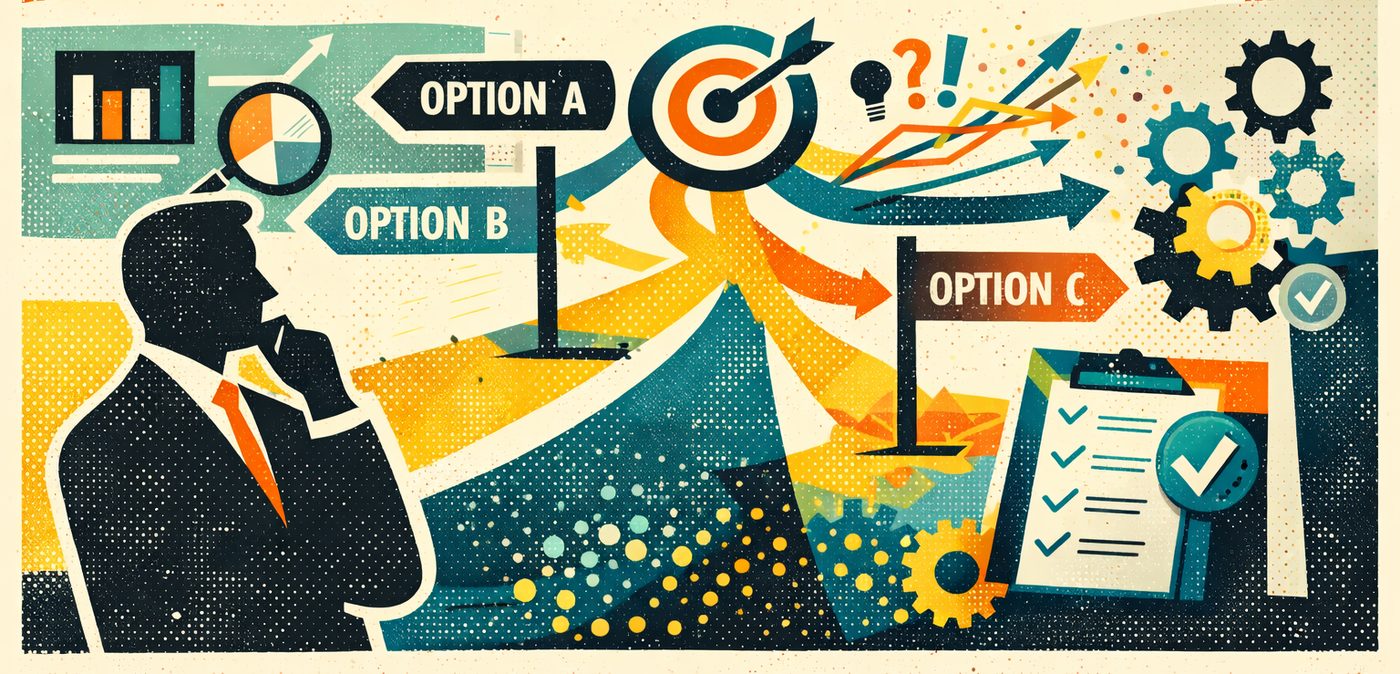
The Gap Between Understanding and Acting
Simulation answers the question: "What happens if we do X?"
But leaders don't just need to explore possibilities. They need to find the best one.
That's where optimization comes in—not as a replacement for simulation, but as its natural extension. Simulation builds understanding. Optimization searches for the decision that performs best across the scenarios that matter.
What Optimization Actually Means in Practice
In business contexts, optimization is rarely about finding a single perfect answer. It's about:
- Identifying which levers have the most impact
- Finding configurations that balance competing objectives
- Stress-testing candidate decisions before commitment
- Ruling out options that fail under realistic conditions
The goal isn't mathematical perfection. It's confident, defensible action.
Why Spreadsheet Optimization Falls Short
Traditional optimization tools assume:
- Linear relationships between inputs and outputs
- Static constraints that don't shift over time
- A single objective to maximize or minimize
- Perfect information about parameters
Real business systems violate all of these. Feedback loops create nonlinearity. Constraints emerge dynamically. Leaders balance cost, speed, risk, and capacity simultaneously. And uncertainty is the norm, not the exception.
This is why optimization must be coupled with simulation—exploring how decisions perform across realistic, dynamic scenarios rather than static snapshots.
Multi-Objective Optimization
Most strategic decisions involve tradeoffs:
- Lower cost vs. faster delivery
- Higher throughput vs. lower risk
- Short-term savings vs. long-term flexibility
Multi-objective optimization doesn't pretend these tradeoffs don't exist. Instead, it maps the frontier of possibilities—showing decision-makers what's achievable and what they're giving up with each choice.
This shifts the conversation from "find me the answer" to "here are the best options and their tradeoffs."
Robust Optimization Under Uncertainty
A decision that looks optimal under one scenario may fail badly under another. Robust optimization seeks decisions that perform well across a range of plausible futures—not just the expected case.
Key questions robust optimization helps answer:
- Which decision holds up if demand is 20% lower than forecast?
- What's the downside if a key assumption is wrong?
- Which option has the best worst-case performance?
- Where do we need contingency plans?
The Human in the Loop
Optimization in complex systems isn't about handing control to an algorithm. It's about augmenting human judgment.
Effective optimization workflows:
- Let humans define objectives and constraints
- Surface surprising or counterintuitive options
- Explain why certain configurations perform well or poorly
- Enable rapid iteration as understanding deepens
The algorithm explores the possibility space. Humans choose based on context, values, and judgment that no model can fully capture.
When Optimization Adds the Most Value
Optimization shines when:
- The decision space is large and manual search is impractical
- Multiple objectives must be balanced explicitly
- Stakes are high enough to justify rigorous analysis
- The system is well enough understood to simulate meaningfully
It's less valuable when the real challenge is understanding the system in the first place, or when political and organizational factors dominate the decision.
The Complete Decision Stack
Bringing it together:
1. System Understanding
Map the feedback loops, delays, and relationships that drive outcomes.
2. Simulation
Explore how the system behaves under different conditions and decisions.
3. Uncertainty Quantification
Capture what you don't know and how it affects projections.
4. Optimization
Search for decisions that perform well across objectives and scenarios.
5. Decision Intelligence
Choose and act with clarity about tradeoffs and risks.
Each layer builds on the one before. Skip a layer, and the next one becomes unreliable.
Moving Forward
Organizations that combine simulation with optimization don't just make faster decisions. They make decisions they can explain, defend, and adapt as conditions change.
The path forward isn't about finding the perfect answer. It's about finding the best answer you can confidently act on—and knowing why it's the best.